
Sustainability improvements for two large government office blocks, despite grid congestion
Approach could serve as a blueprint for government real estate throughout the Netherlands
Despite the congested electrical grid, the Dutch Central Government Real Estate Agency is giving two large office blocks in The Hague a more sustainable energy supply. The buildings’ electrical connections are being combined to make more efficient use of sustainable geothermal heat and cooling without further stress for the grid. This energy hub is possible thanks to a close partnership between the EnergieRijk Den Haag (ERDH) programme, Stedin and Eneco. “Approaching the issue by looking beyond individual buildings offers possibilities for reducing the fossil dependency of government properties all over the Netherlands, and so making their energy supply more resilient,” explains ERDH programme director Frans Deeleman.
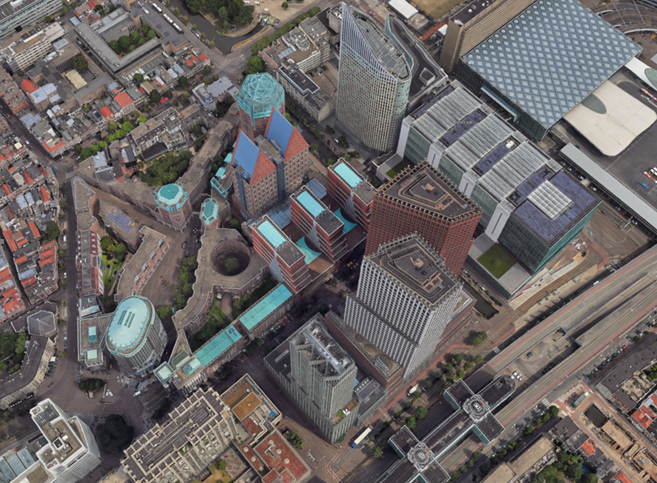
The buildings on Parnassusplein house approximately 3,500 employees of institutions such as the Ministries of Social Affairs and of Health, Welfare and Sport and the Netherlands Authority for Consumers and Markets. Making the heating and cooling system in the two buildings more sustainable required an extra heat pump. This was impossible, however. One of the buildings did not have enough contracted electrical capacity, and the congestion on the electrical grid meant that its contract could not be expanded. As the other building had capacity to spare, the solution was to consider the two buildings together.
Looking at the buildings from a broader perspective made it possible to set up an energy hub. EnergieRijk Den Haag, grid operator Stedin and energy company Eneco are working together closely to optimise how supply and demand for the local energy can be matched. The buildings’ separate electricity contracts will be converted into a collective contract known as a Group Transmission Agreement. The buildings will only consume as much energy as the available capacity allows. This will not overstress the grid, so an extra heat pump can be installed to make optimum use of Eneco’s sustainable thermal source by the buildings. This will also make the buildings significantly more sustainable: at optimum efficiency, using the thermal system can save up to 124 tonnes of CO2 per year.
To relieve the stress on the grid and improve the overall energy system, ERDH and Eneco are also exploring possibilities for integrating the district battery at Rijnstraat 8 into the energy hub.
“We need these kinds of smart partnerships that look beyond the energy needs of individual properties,” comments Stedin’s Regional Director Maarten Bijl. “That’s the only way to meet the rising demand for electricity. We can’t upgrade the electrical grid endlessly, so these innovative projects are a key to making the whole country more sustainable.”
“Improving the sustainability of these two office blocks has yielded practical experience with setting up and designing energy hubs,” adds Max Droste, Director Strategy and Digitalisation of the Central Government Real Estate Agency. “More importantly, we’ve learned about addressing sustainability above the level of individual properties. This will make solutions feasible that otherwise would be impossible. Together with our partners, we’ll consider where else we can apply this approach.”
“A smarter and broader perspective of properties within a particular area, and seeing the heating, cooling and electrical energy systems as a collective unit, will offer great opportunities for sustainability despite the challenges of grid congestion,” says Director Ron Wit of Eneco’s Heating division. “If energy partners work together closely to make efficient use of our energy sources and the electricity capacity, a great deal can still be achieved in the Netherlands.”